Hash the data structure of a dataset for a given column
Source:R/csfmt_rts_generics.R, R/csfmt_rts_v2_structure.R
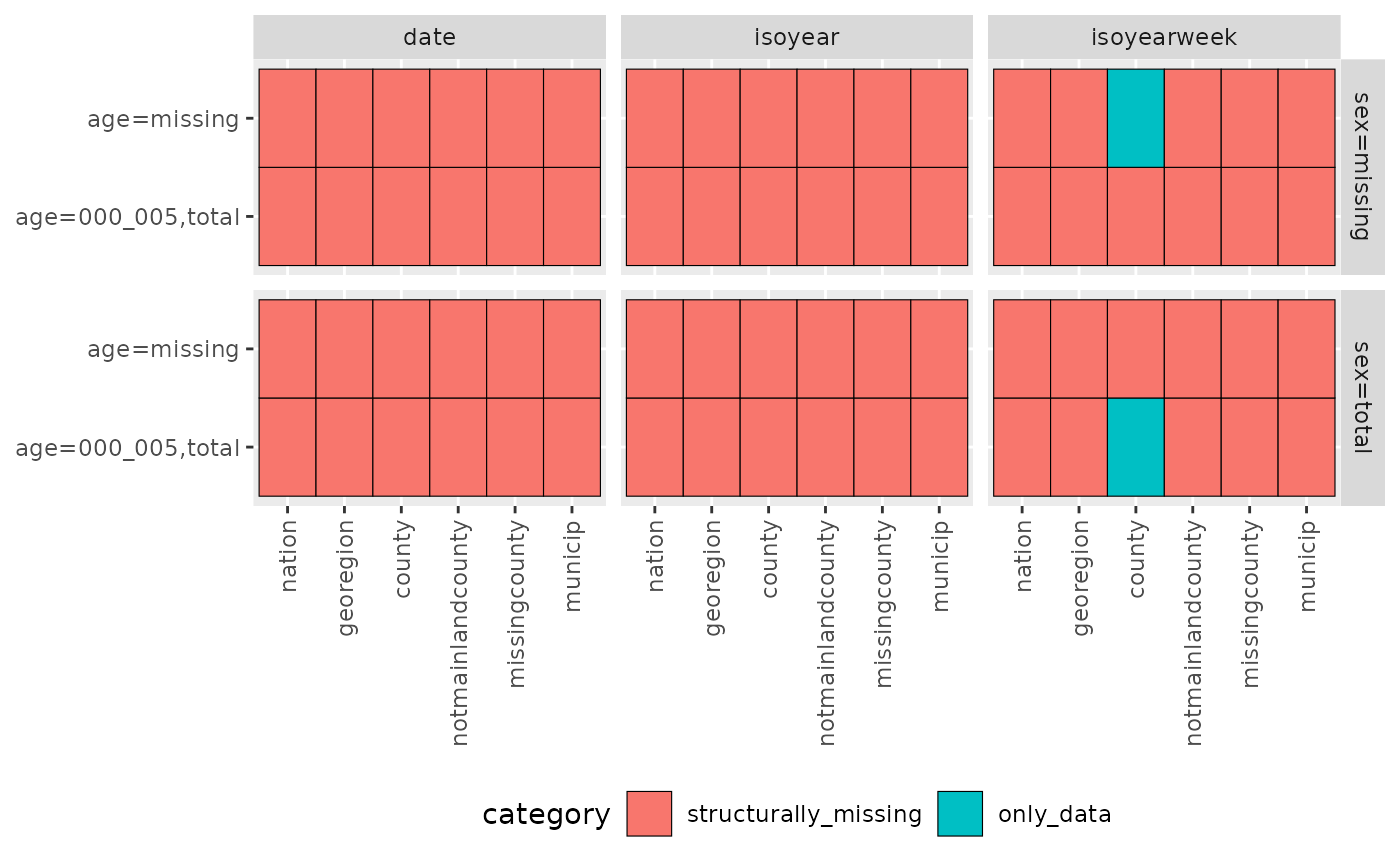
identify_data_structure.RdSummarises the data structure of a single column inside a dataset. For each
combination of granularity_time, granularity_geo, age and sex it records the
state of the column. The four states are structurally missing, only NA, only
data, and a mix of data and NA. Pass the result to plot() for a visual
overview.
Usage
identify_data_structure(x, col, ...)

# S3 method for class 'csfmt_rts_data_v2'
identify_data_structure(x, col, ...)

# S3 method for class '`tbl_Microsoft SQL Server`'
identify_data_structure(x, col, ...)
Arguments
- x
An object of type
csfmt_rts_data_v2.- col
Column name (character) whose data structure is summarised.
- ...
Arguments passed to or from other methods.
Deprecated
The csfmt_rts_data_v2 method of identify_data_structure() is deprecated
along with the format it dispatches on. Nothing warns at run time. See
set_csfmt_rts_data_v2(). Neither the generic itself nor its
tbl_Microsoft SQL Server method is deprecated.
See also
Two vignettes run this function and plot the result:
vignette("cstidy", package = "cstidy") and
vignette("csfmt_rts_data_v2", package = "cstidy").
Other csfmt_rts_data:
expand_time_to(),
remove_class_csfmt_rts_data(),
set_csfmt_rts_data_v1(),
set_csfmt_rts_data_v2(),
set_csfmt_rts_data_v3(),
unique_time_series()
Examples
cstidy::generate_test_data() |>
  cstidy::set_csfmt_rts_data_v2() |>
  cstidy::identify_data_structure("deaths_n") |>
  plot()